
Configuring Workflow Start/Stop Conditions
Workflow start and stop conditions allow you to control how it operates. You can define conditions under which the workflow will run automatically — for example, to make it start or stop only at a specific time or after certain events occur (such as when a contact fills out a form, starts subscription etc.).
You can set start/stop conditions in two ways:
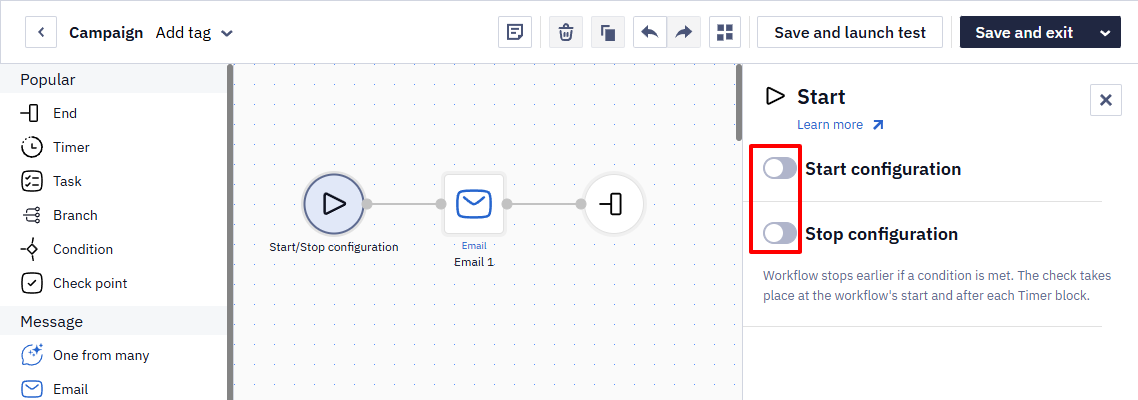
- In the Start block settings.
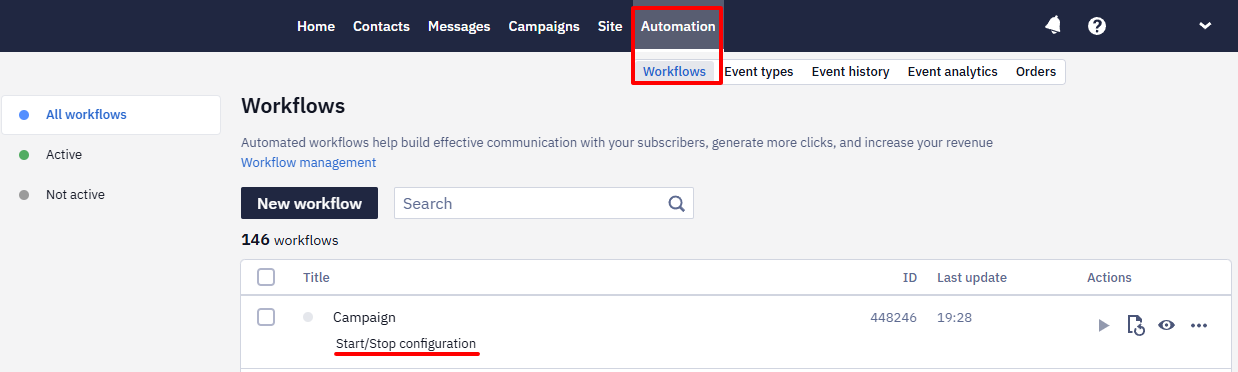
- In the general workflow list (Automation → Workflows section).
Click Start/Stop configuration next to the desired workflow.
Setting Up Start Configuration
-
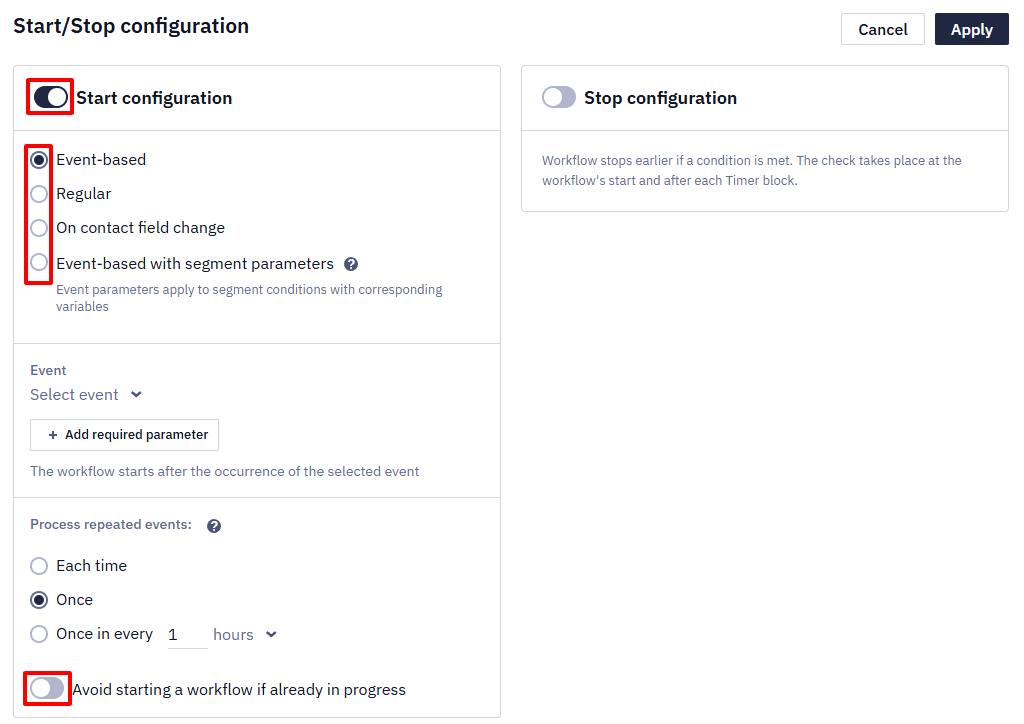
Enable the Start Configuration slide button.
-
Select one of the following conditions:
- Event-based
- Regular
- On contact field change
- Event-based with segment parameters
- Select the settings specific to the selected condition, as described below.
- When the Avoid starting a workflow if already in progress option is enabled, the workflow will not be launched for contacts that are already in the process of running it. For example, if a user receives a chain of reminders about an unlearned lesson and doesn’t complete a new lesson during this period of time, the workflow will not react to this event.
- Click Apply.
After you change the start conditions of a workflow that is already active and save it, the workflow becomes inactive. Activate it again so that the new conditions take effect.
Event-based Start Configuration
The event-based settings in the start configuration allow you to start the workflow upon the occurrence of a specified event.
When you select Event-based, you can set up the following workflow settings:
- Event
- Required event parameters
- Process repeated events
Selecting event
Select an event to start a workflow.
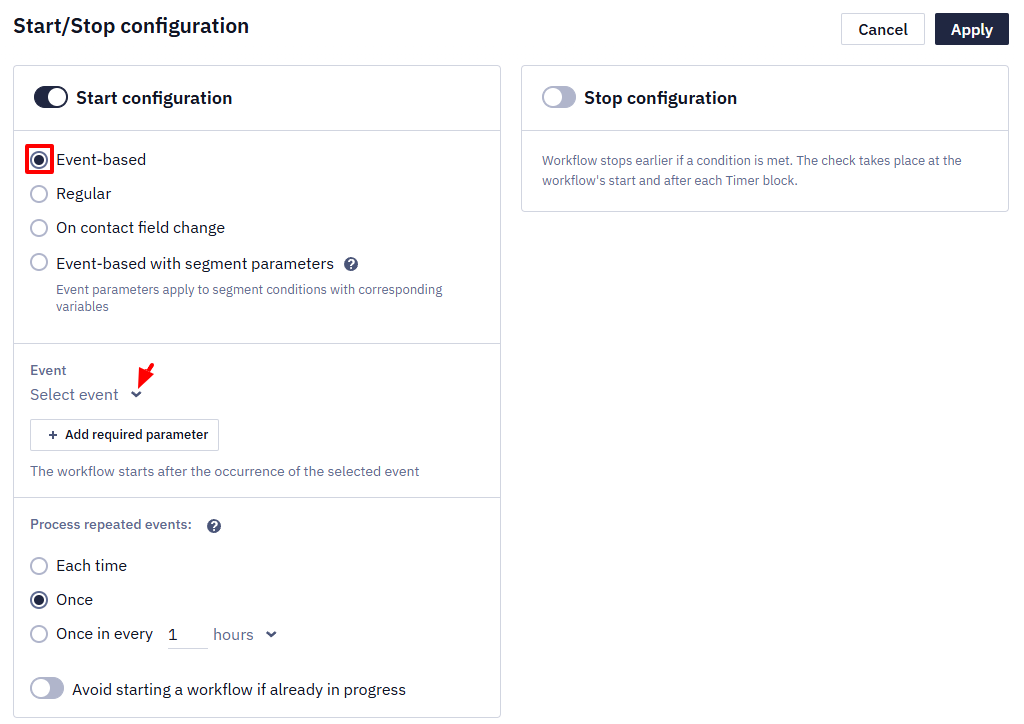
The workflow will start when the selected event occurs.
The same event can trigger different workflows, which allows you to divide complex schemes into separate, independent chains of conditions and actions
Selecting Required Parameters
The workflow will only launch if the event parameters meet the conditions set in this section: for example, only if the purchased products match a certain category.
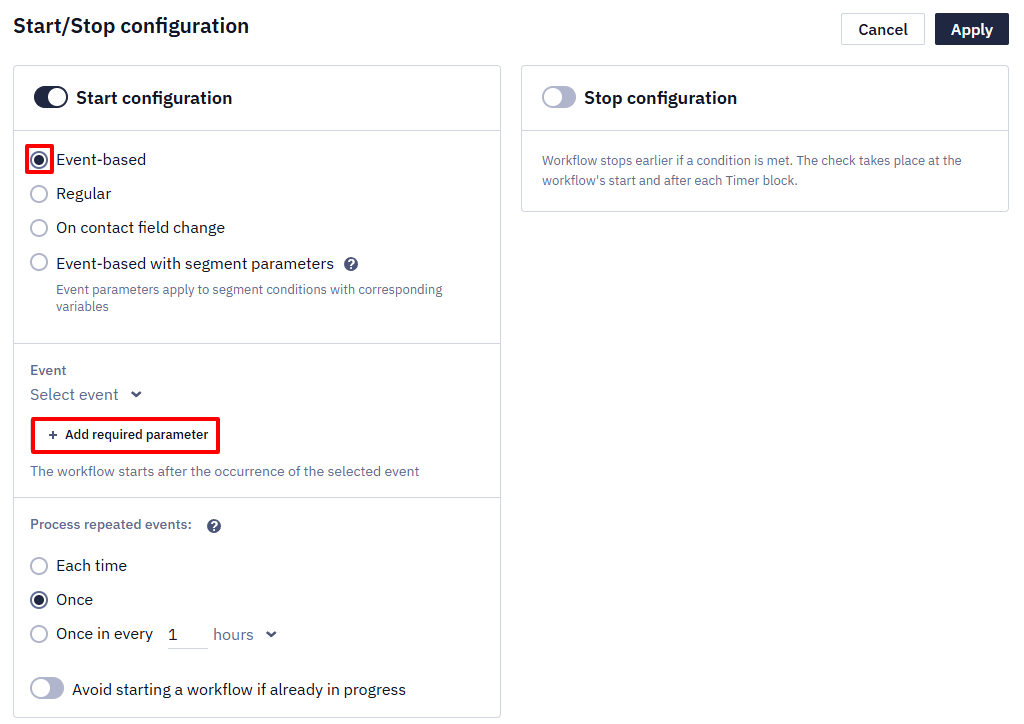
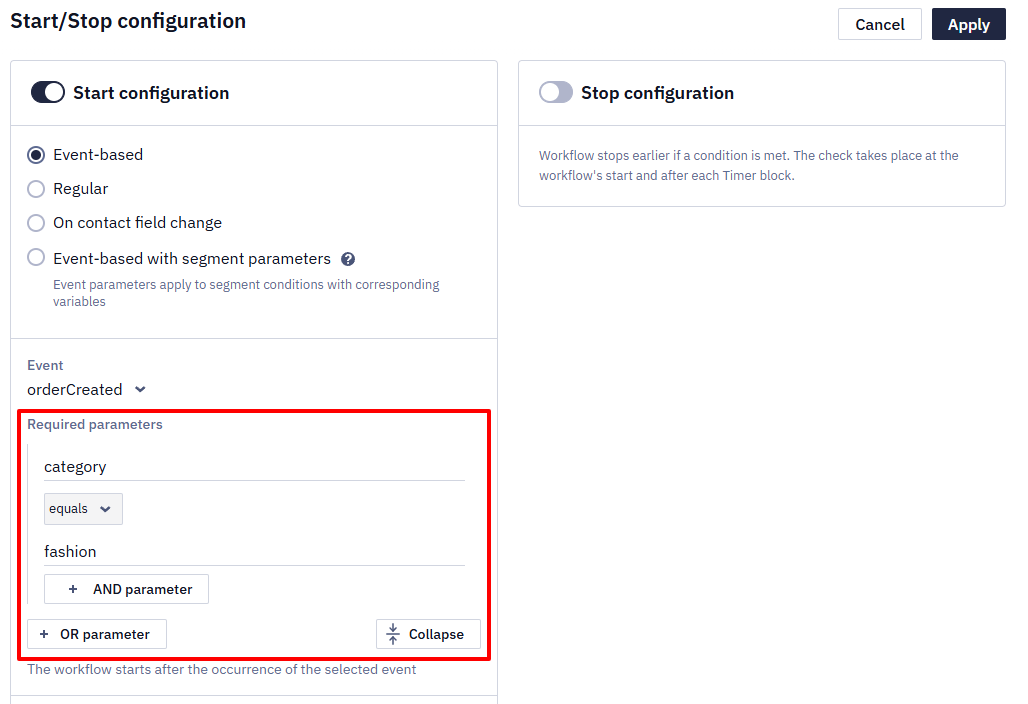
To set up a condition, click the Add required parameter button and specify the event parameter and the value you want to check it for.
To access nested parameters in the event payload, use the following selector formats:
- Dot selector —
order.orderId - Index selector —
items[0] - Combined —
order.items[0].title
This allows you to filter workflow starts by values inside complex objects and arrays, not just top-level fields.
The following check options are available:
- equals,
- does not equal,
- is set,
- is empty,
- is true,
- is false,
- contains,
- does not contain,
- starts with,
- does not start with,
- ends with,
- does not end with,
- one of,
- is not one of.
For boolean event parameters, such as isFirst, you can use is true, is false, equals, does not equal, is set, is empty, contains, does not contain, starts with, and does not start with. For direct true/false checks, use is true or is false, or use equals with true or false.
If necessary, you can add checking for other values (AND/OR conditions, their number is not limited).
Selecting Process repeated events
The process repeated events define whether to:
- Repeat the workflow every time when an event occurs.
- Stop the workflow after the selected event occurs once.
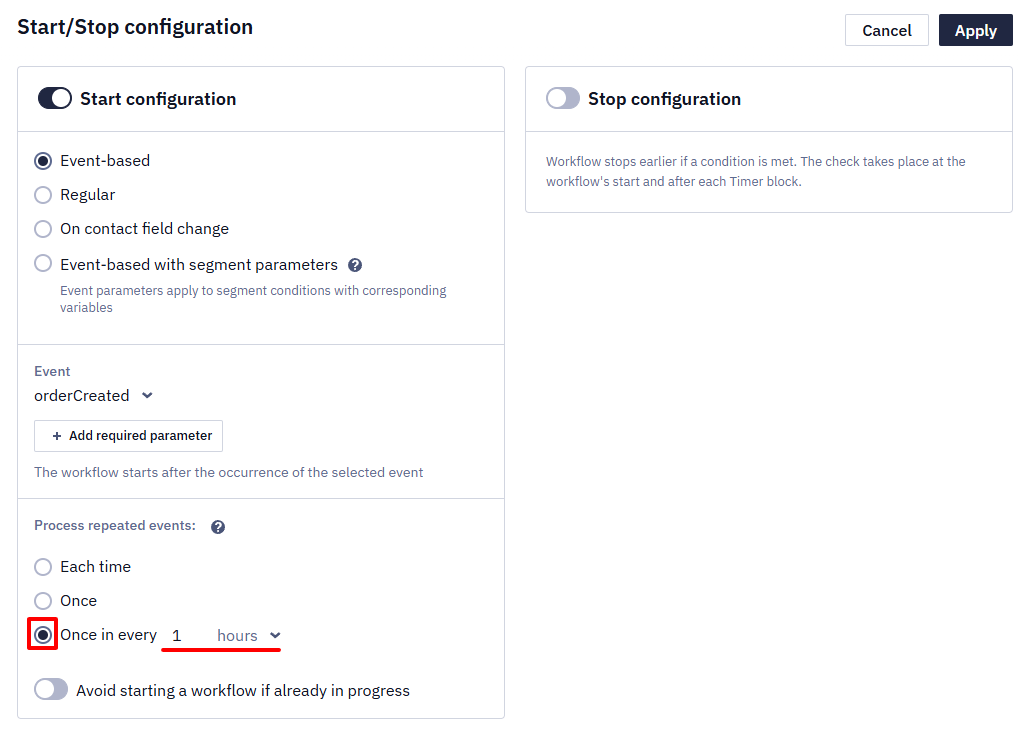
- Run the workflow only once during the specified time, no matter how many times the specified event occurs during that time.
To select the required condition, select the radio button beside Process repeated events.
If you select the Once in every condition, enter the value in the field and select its definition from the dropdown list.
How launch uniqueness is countedWithout a uniqueness condition, every repeat event with the same key starts the workflow again — there is no automatic event deduplication, so limit repeat launches with this setting.
The uniqueness of launches is counted from the contact's launch history and does not depend on later edits to the workflow or its start conditions. Changing the settings doesn't reset previous launches — if a contact has already gone through the workflow within the uniqueness period, the new settings won't make it start again for them.
With the option to run the workflow only once, the workflow won't start again for the same contact even when new events of the selected type arrive, and creating a copy of the workflow doesn't bypass this. To send the campaign to such contacts again, pass a different (new) event type and create a separate workflow launched by it.
Changing the start conditions doesn't reset the uniqueness timer. If the workflow is limited with an option such as Once in every, the period keeps counting from the previous launch.
Regular Workflow Start Configuration
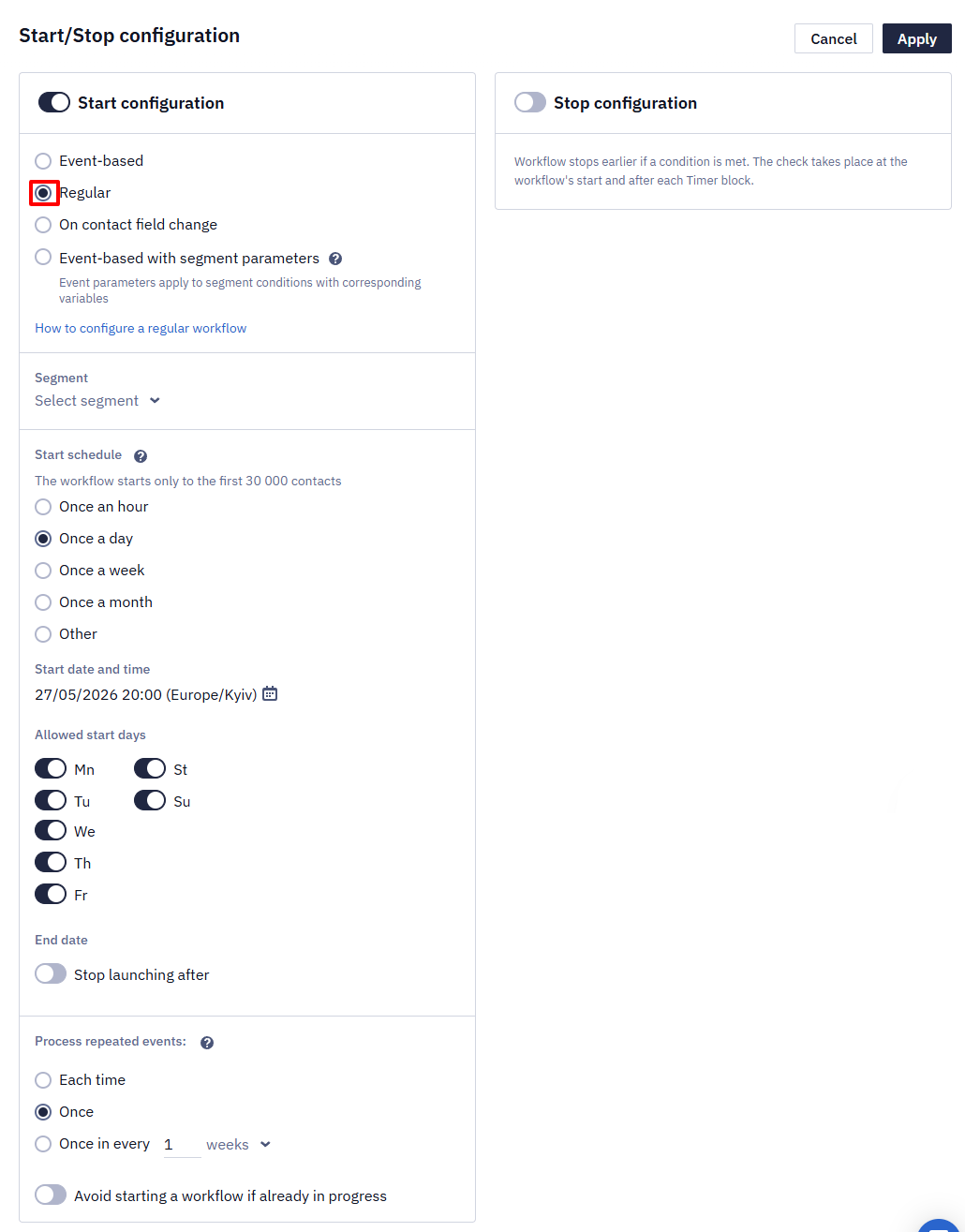
Workflow configuration settings:
- Segment. It allows you to select a segment of contacts.
- Start schedule. This setting defines the frequency of a workflow.
- Start date and time. This setting defines the workflow start date and time.
- Allowed start days. This setting allows you to set the specific days of a week for running a workflow.
- End. This setting allows you to set the workflow end date.
- Process repeated events. See Selecting Process Repeated Events.
- Avoid starting a workflow if already in progress.
The Segment field lists only dynamic segments.
When you add the segment in the settings, you can proceed to its preview or copy the ID.
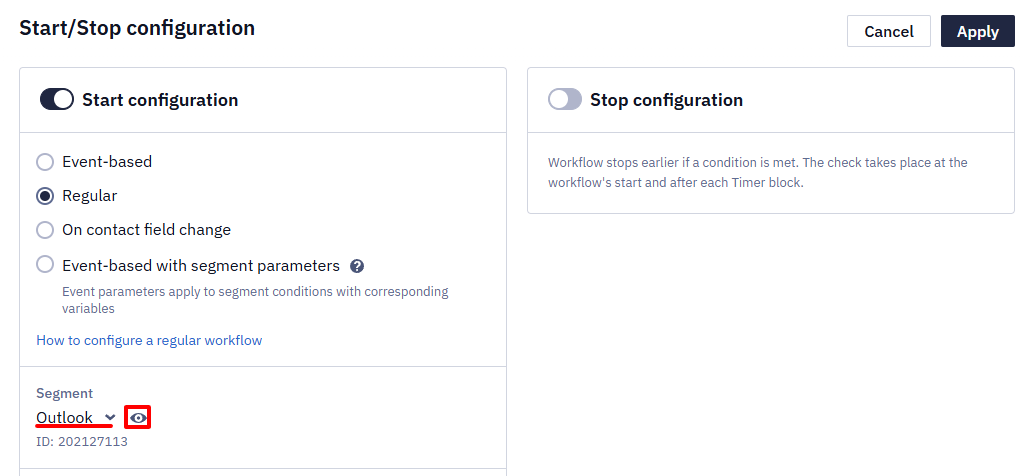
The set values of date and time in the start configuration mean that the campaign will launch when the specified time and date occur. For example, if you set the start time from 09:00 to 10:00 once a day, it means that the workflow will automatically run within the specified time each day. You can't set an exact minute: the workflow starts at some point within the selected hour.
The same applies to the allowed start days — if you specify that the workflow should only be launched on Tuesday and Thursday, then it will only be automatically started on those days.
A scheduled (segment-based) workflow has no limit on segment size. At the start time, the system takes a snapshot of the segment, and every contact in the snapshot goes through the workflow. The snapshot is processed in batches of 10,000 contacts every 10 minutes, which is 60,000 contacts per hour for each launch. For a large segment, the first batch enters the workflow only after the segment is built; a small segment starts without a noticeable delay.
Processing time depends on the number of contacts, so a large segment can take several hours. For example, a segment of 1,000,000 contacts takes about 17 hours: a launch at 09:00 finishes at about 02:00 the next night. If the message has to reach everyone at about the same time, keep the trigger segment small, for example by excluding contacts who have already gone through the workflow.
Contacts who join the segment after the snapshot enter the workflow at the next launch. While a launch is in progress, the following scheduled launches of the same workflow are skipped, and the next launch starts at the first scheduled time after the current one finishes. With Once a day, for example, the next day's launch is skipped if processing the segment takes more than 24 hours.
After you deactivate the workflow, the current launch still processes the whole segment.
A launch appears in Launch statuses per segment only after it finishes.
On Contact Field Change Start Configuration
When you select the On contact field change option, the workflow starts every time when the selected field changes for a selected contact.
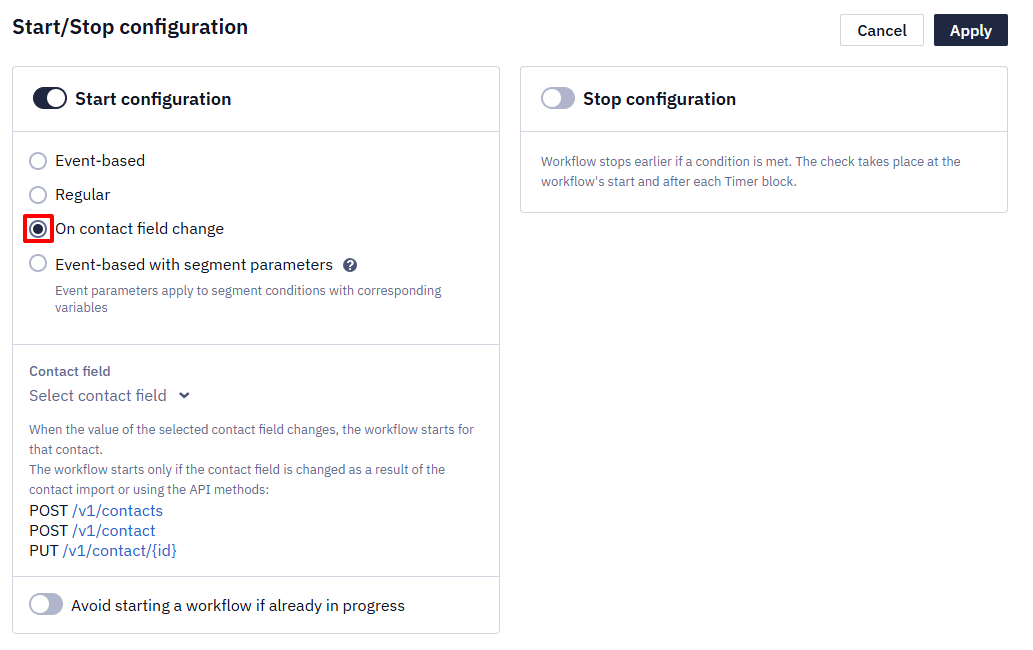
The workflow starts when the contact field changes as the result of the contact importing or using the following API methods:
Creating a contact doesn't start such a workflow: the field has to change for an existing contact. To reach new contacts, start a regular workflow for a segment — a new contact then enters the workflow not immediately, but on its next run (at most once an hour).
Event-based with Segment Parameters Start Configuration
The workflow starts when the segment parameter matches the event parameter.
NoteThis configuration and the Dynamic with parameters segment type are not enabled in every account. If you don't see them, contact support and describe the case. The option is opened for cases that the Event-based and Regular configurations can't cover — for example, when a contact's membership in a segment has to be checked at the moment the event arrives, against a parameter carried by that event.
Example of use: When new chapters are released in a certain book, you need to send a corresponding notification to all contacts who have read this book.
Settings
- In the workflow editor, open the Start block and enable Start Configuration.
- Select Event-based with segment parameters and specify the event.
- In the Segment field, select an existing Dynamic with parameters segment or create a new one without leaving the workflow editor.
- In the segment conditions, specify the segment parameter that should correspond to the event parameter. In our case, the segment parameter is the ID of the book the contact is reading (
bookStartedBookId), and the event parameter is the dynamic variable of the updated book ($bookUpdatedBookId).
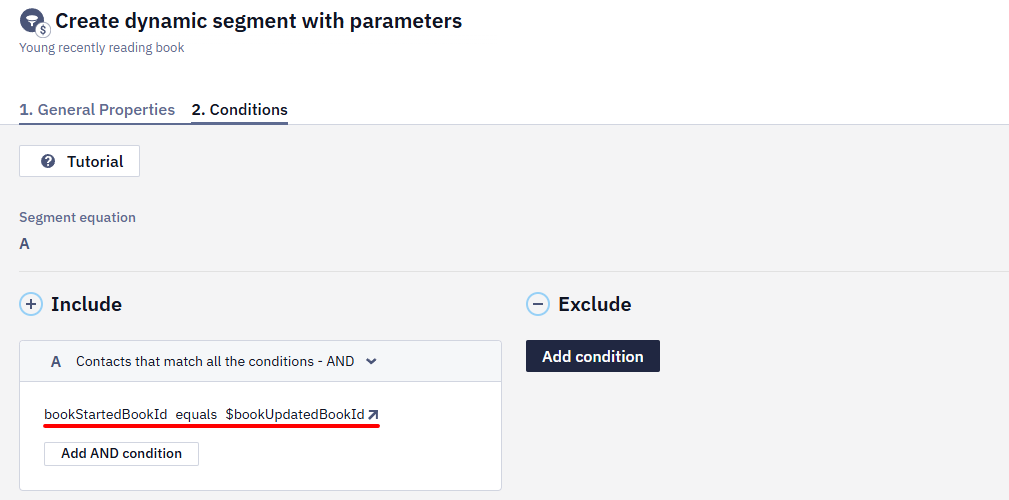
- Save the segment to return to the start configuration. The created segment is selected in the Segment field.
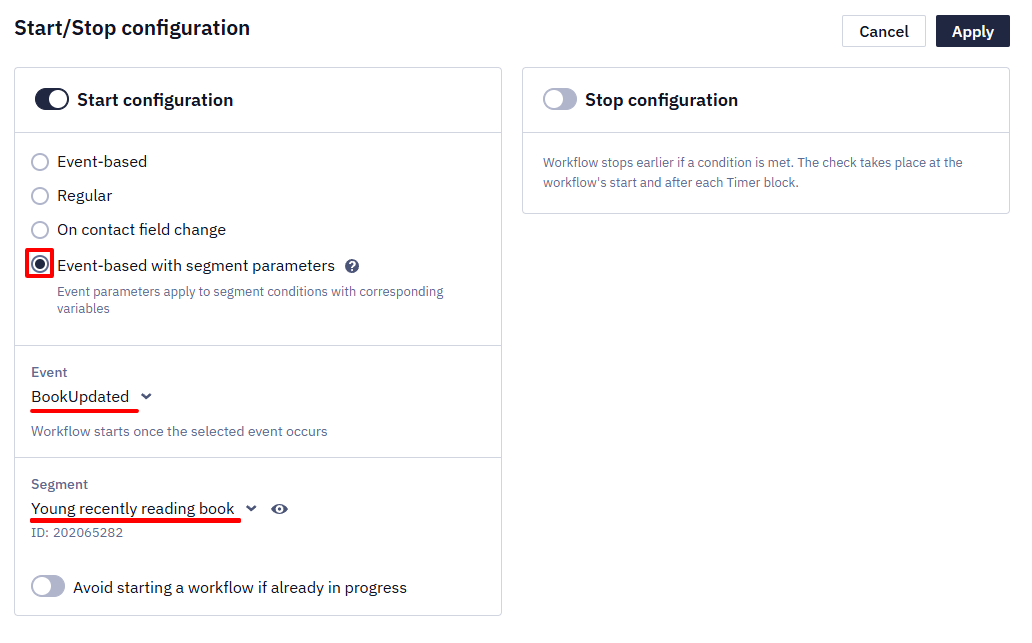
When an event with the ID of an updated book is received, contacts reading the same book will receive a notification through the workflow.
Setting Up Stop Configuration
NoteStop Configuration is defined inside the same Start block settings as Start Configuration — despite the name, both are part of one JSON object in the Start block.
You can edit Start/Stop Configuration in the Start block settings inside the workflow editor. It is also available from the workflows list through Start/Stop configuration.
To set up stop configuration for a workflow:
-
Enable Stop Configuration slide button.
-
Select one of the following conditions:
- Event-based
- Included in a segment
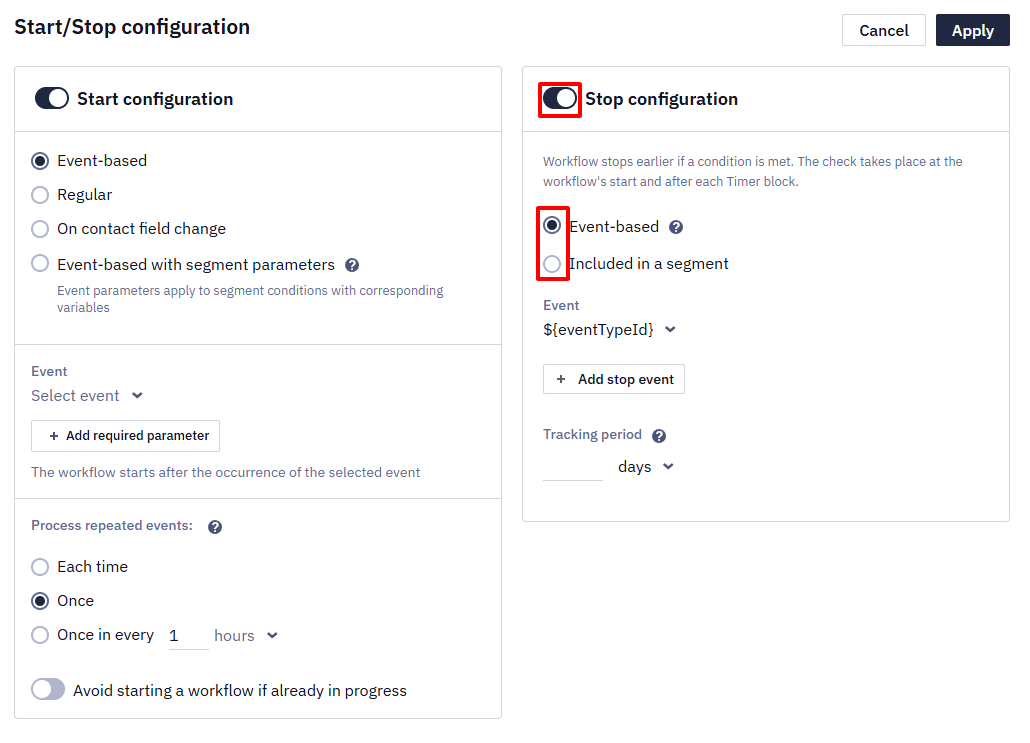
- Select the settings specific to the selected condition, as described below, then click Apply.
Workflow stops earlier if a condition is met. The check takes place at the workflow's start and after each Timer block.
Event-based Stop Configuration
The event-based condition stops the workflow when one of selected events occurs (or happened before the workflow was started).
A workflow with an event-based stop condition can't be checked by a manual run: at Launch one time or a test launch there is no way to pass the event key. To test such a workflow, turn off Stop configuration for the test or launch the workflow with a real event.
To configure the stop on the event option:
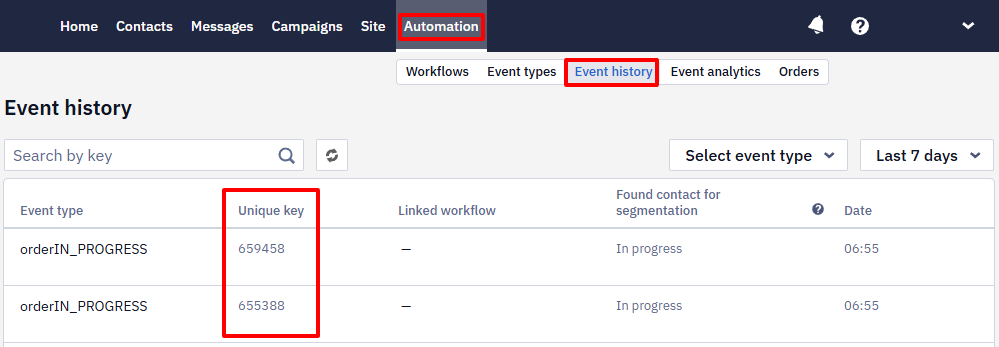
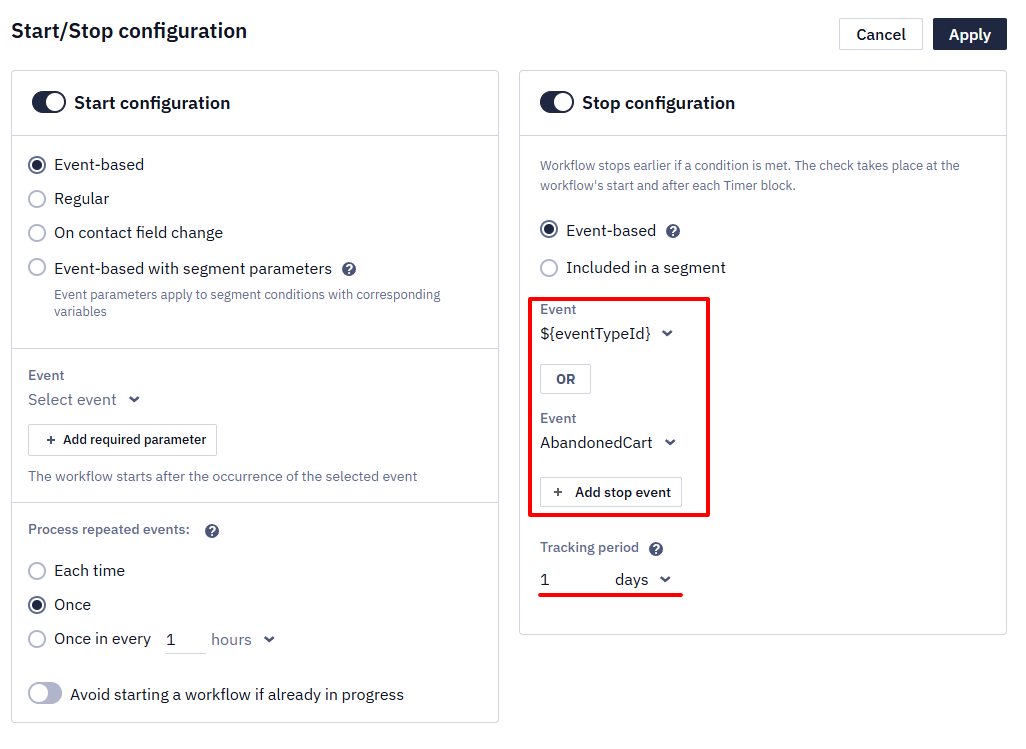
- Select one or more events. The workflow will stop by
contactIdif it is contained in one of the specified events, even if they have different unique keys. If the event does not contain acontactId, the workflow stops by the unique key of that event. To view unique event keys, go to Automation → Event history.
- Enter the period value (max 2 years). The workflow will stop if the event occurs within the specified period before its launch.
Included in a Segment Stop Configuration
The Included in a segment condition stops the workflow when the contact is included in a specified segment. Segment membership updates with a delay of up to an hour, so the workflow may not stop in time for a contact who has just been added to the segment. To stop the workflow right after a contact's action, select the Event-based stop condition and specify the events.
To set up a stop condition by including in a segment, select it from the list or specify a dynamic variable in brackets – the name of the start event parameter containing the segment ID.
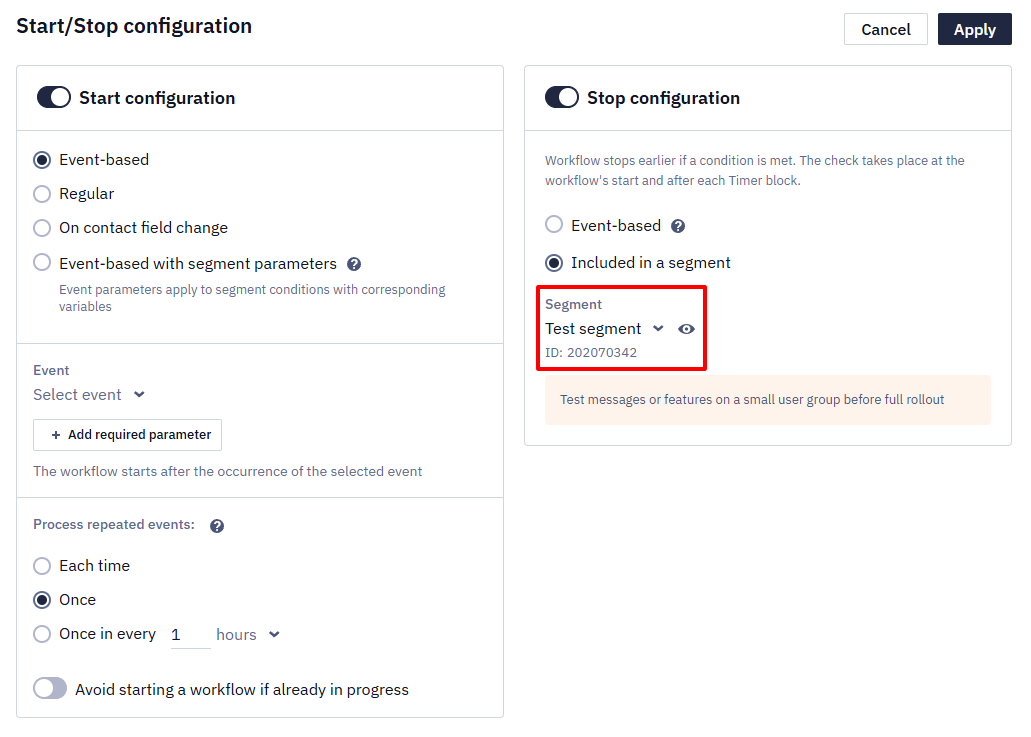
After selecting the segment, you can preview it by clicking the preview icon.
When the workflow is stopped by including in a segment, the system searches for a contact by contactId, if it is not specified, by other identifiers.
Updated 2 days ago