
What's New for August
August focused on AI-assisted workflow building and clearer performance visibility. You can now:
- build and update workflows with the AI assistant right in a chat;
- see condition results directly in the workflow launch history;
- track unsubscribes, spam complaints, and errors on the home page dashboard;
- choose where App Inbox messages appear — the website, the app, or both;
- route widget visitors to different pages based on their actions;
- automate more integrations with OAuth 2.0 Client Credentials and expanded language-code support.
You can review the July updates in the previous digest; the latest SDK versions are available in the release notes.
Workflows
AI Assistant in the Workflow Editor
Enable the AI Chat toggle on the workflow editor's top panel, and an assistant panel opens next to the canvas.
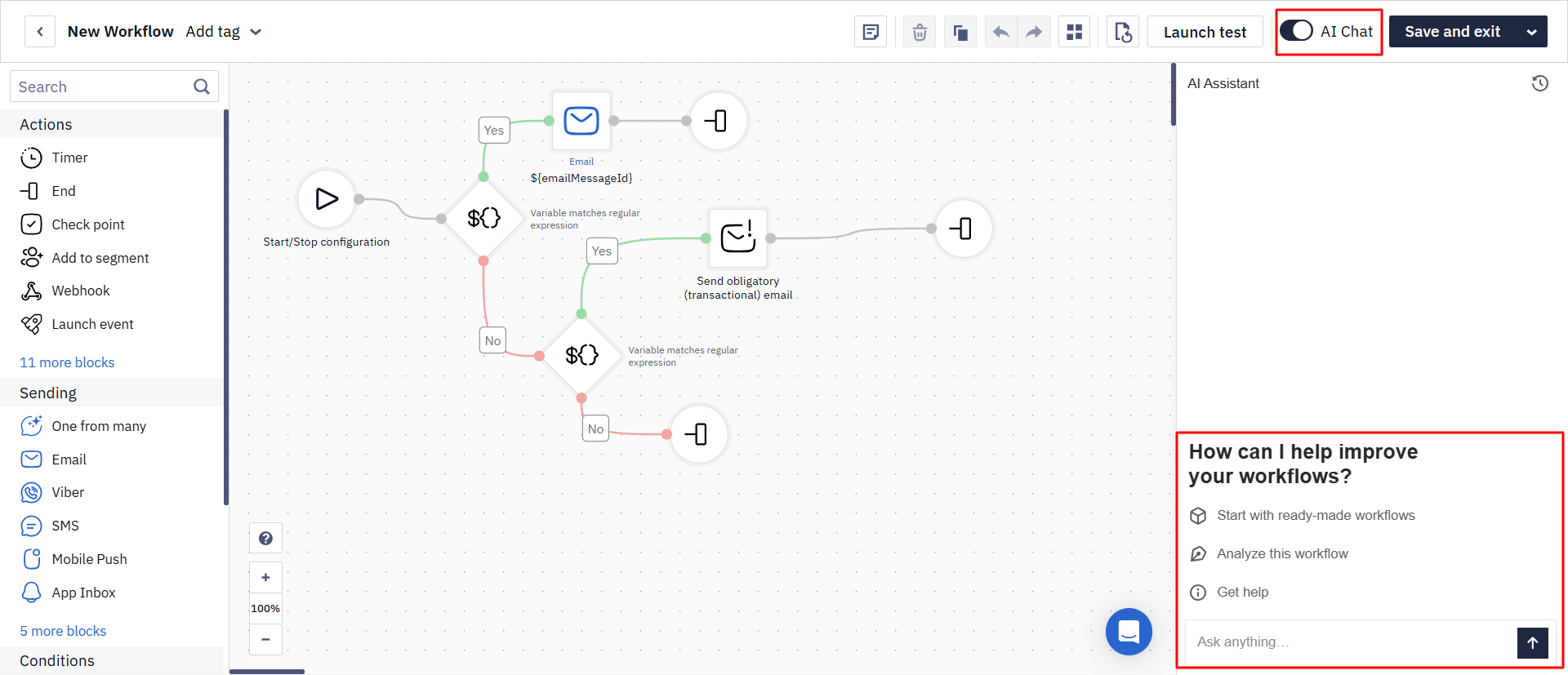
The assistant can:
- create a workflow from your description;
- edit an existing workflow: add or remove blocks, change connections, timers, and conditions;
- analyze a workflow: check its logic, settings, and structure, and suggest improvements;
- answer questions about blocks, their settings, and how to phrase requests.
Routine tasks no longer require editing every step by hand or switching to the documentation: ask the assistant to change the workflow logic, review it before launch, or build your first workflow from a chat description. The functionality is available in beta.
See AI Assistant in the Workflow Editor.
Condition Block Results in Launch History
Launch history keeps getting more transparent: after July's block-configuration view, you can now see how each condition block ended — right in its row, without opening the block. For example:
- blocks with yes/no branches show the check result: Opened? — whether the user opened the message, Included in Segment? — whether the user belongs to the selected segment, Check Values — whether a contact field or event parameter matched the specified value;
- the Split block shows the percentage of the branch the user followed, for example 30%.
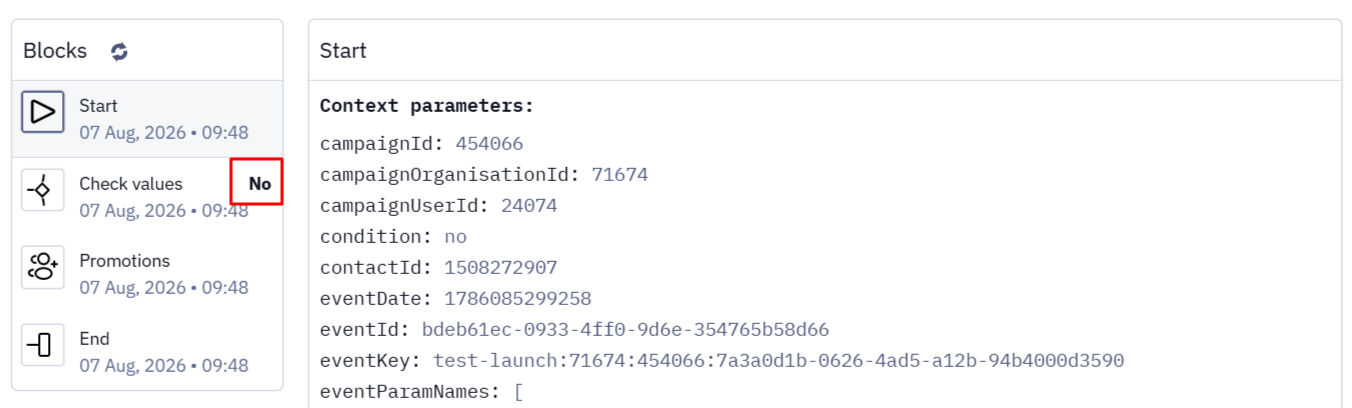
This speeds up logic checks and helps you find the reason for an unexpected transition.
See Using Workflow Launch History.
Help and Keyboard Shortcuts in the Editor
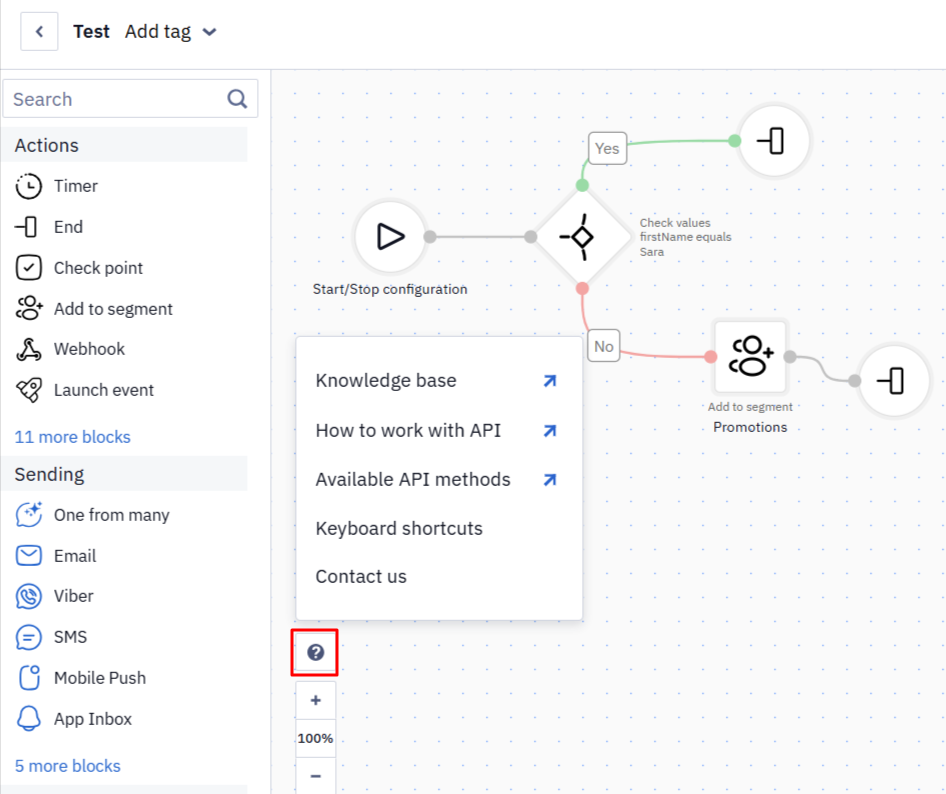
A ? icon now sits in the bottom-left corner of the workflow editor. Clicking it opens a menu with links to the knowledge base, API instructions, the API resource list, support chat, and keyboard shortcuts for editing workflows. The hints stay at hand without switching to a separate tab, and repetitive workflow actions get faster.
See Building and Editing Workflows.
Edit SMS Messages in the Workflow Editor
SMS joins Email and Mobile Push: you can now create and edit SMS messages directly from the sending block, without opening a separate tab or losing the workflow context.

See Sending Blocks.
dateTool Expressions in the Branch Block
The Branch block conditions now support dateTool expressions — a set of Velocity functions for calculating and comparing dates.
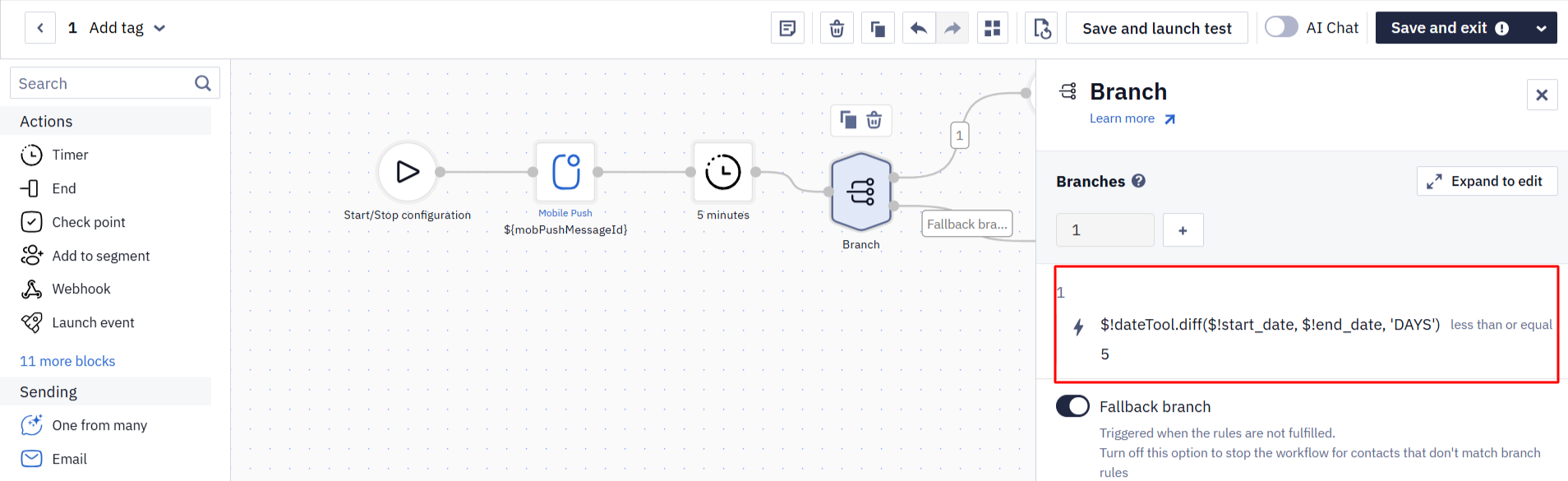
For example, $!dateTool.diff($!start_date, $!end_date, 'DAYS') returns the number of days between two dates. Based on this value, the workflow can pick the right branch: remind a user before their membership ends, start reactivation after a period of inactivity, or skip a step if the target date hasn't come yet.
See Using Branch Block.
Analytics
More Metrics on the Home Page
The home page dashboard gets new metrics in two formats: absolute values — Unsubscribed, Spam, Errors — and percentages — Unsubscribe rate, Spam rate, Error rate.
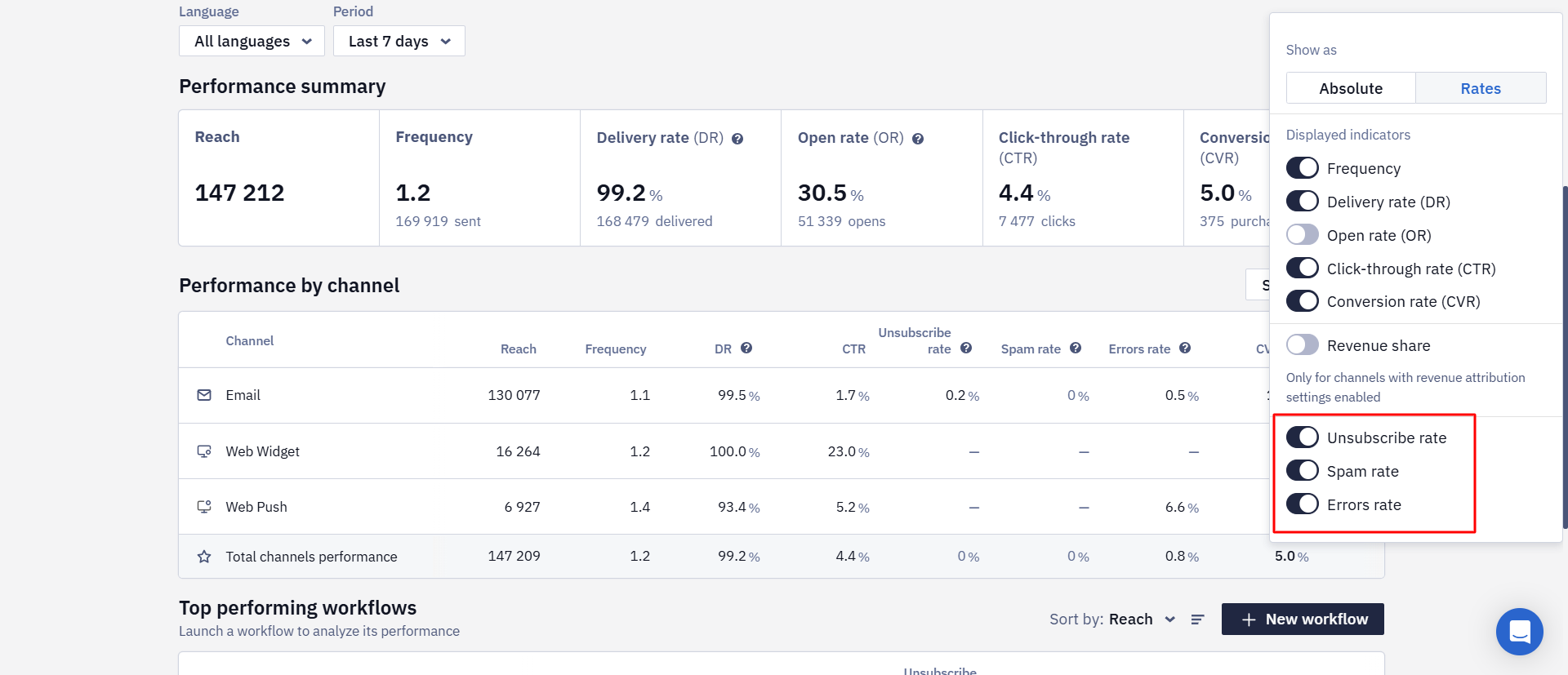
Unsubscribes and spam complaints are available for Email. Errors and the error rate can be viewed for all channels except widgets. The metrics appear in the Channels and Top performing broadcasts blocks; switch between Absolute and Rates, and apply filters by period, channel, and conversion event.
This makes it easier to notice list-quality or delivery problems without opening a separate report for every campaign.
See Home Page Performance Dashboard.
App Inbox
Choose the Platform for a Message
In the additional message parameters, you can now pick one of three display options: Website and mobile app, Website only, or Mobile app only. For new and existing messages, Website and mobile app is selected by default.
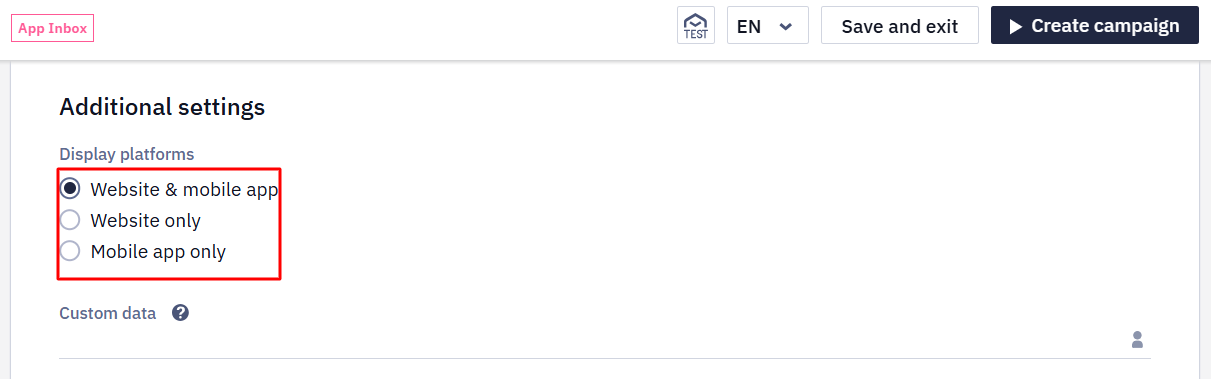
The new setting helps you avoid duplicating a message where it isn't needed: show an in-app feature tutorial only to app users, and a web-account notice only on the website.
See Creating App Inbox Messages.
Widgets
Page Transitions Based on Visitor Actions
Multi-page widgets can now send the visitor to a page depending on their action. Build NPS surveys, quizzes, and progressive-discount mechanics without workarounds: if the visitor declines the first offer, the next page can propose a bigger discount.
Two editor updates support this:
- The Open widget page action gets a Require fields toggle. Previously the form was always validated before moving to the next page; now you can turn the check off so the visitor can continue without filling in all the fields.
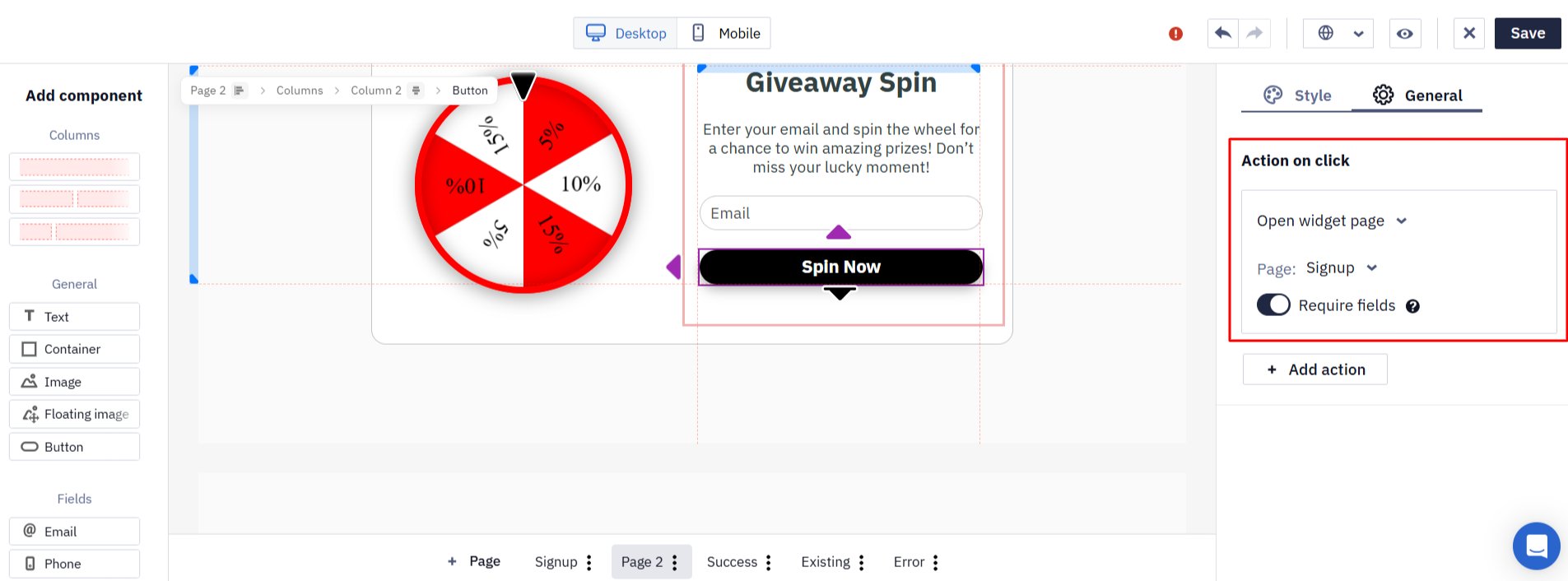
- The editor shows each button's role in the flow: on intermediate pages the action is called Next page, and where the form data is actually sent — Submit form. You can see at a glance at which step the form gets submitted.
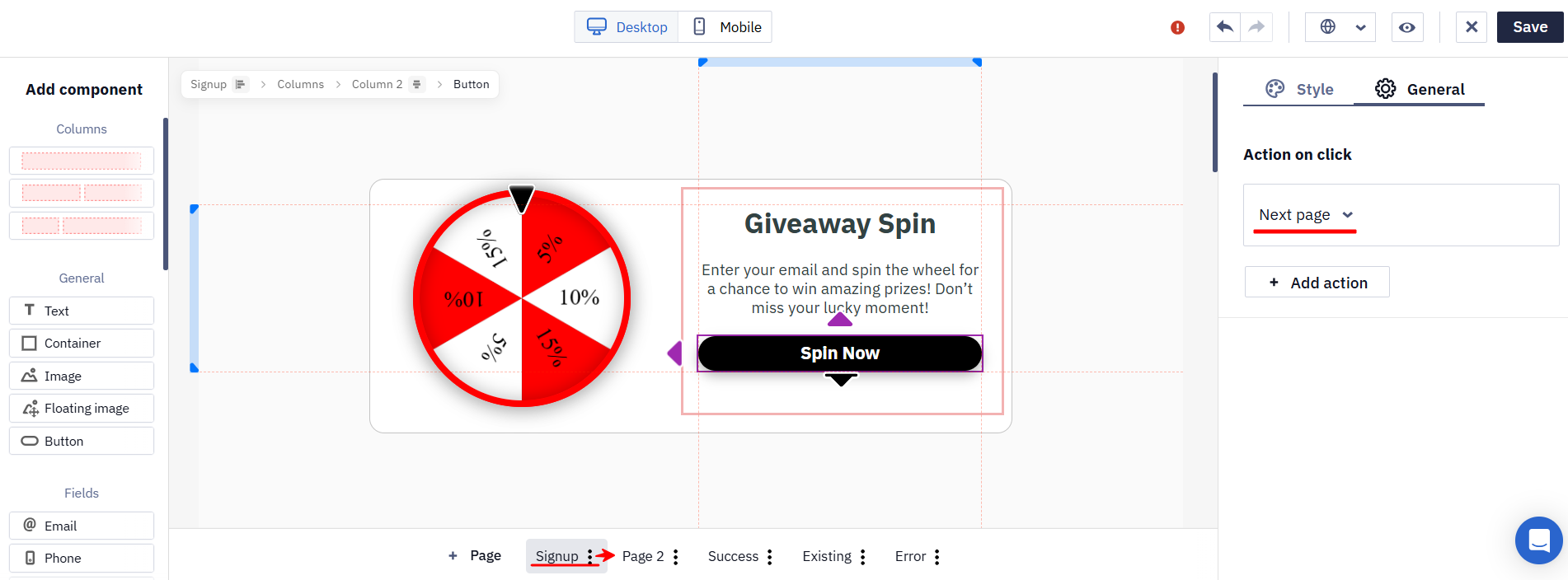
See Actions After Form Submission.
Segmentation
Separate Address and Current-Location Fields
In the segment condition builder, the City, Region, and Country fields now specify their data source — the user's address or their current location. For example, you can set separate City (Address) and City (Location) conditions.
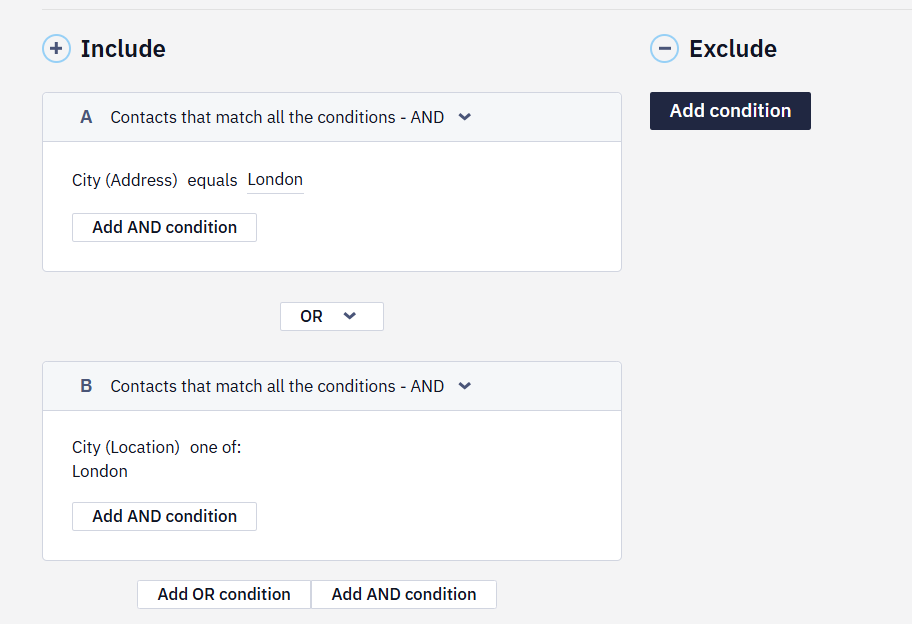
Address data usually comes from the contact card or an import, while location data can be detected from user activity. Clear names help you pick the right source and avoid building a segment on the wrong same-named field.
API and Integrations
OAuth 2.0 Client Credentials for HTTP Data Sources
Through an HTTP data source, Reteno pulls data from an external system to insert into messages or pass along during workflow execution. For such a connection you can now select the OAuth 2.0 authorization type with the Client credentials grant.
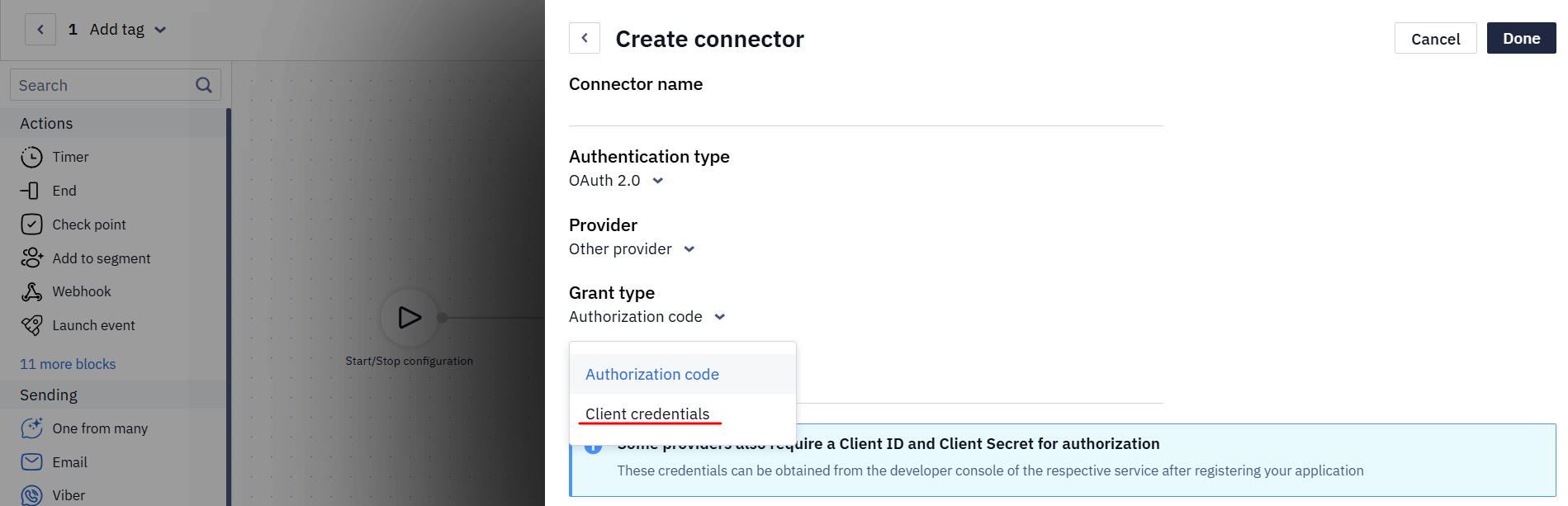
Specify the Token URL, Client ID, Client Secret, and, if needed, Scopes. Reteno obtains the token itself, passes it in the Authorization: Bearer header, and requests a new one when it expires. This flow suits server-to-server integrations without user involvement, including Microsoft Entra ID.
See Connecting to HTTP Request as an External Data Source.
All ISO 639-1 Language Codes
Multilanguage messages and API requests now accept all valid two-letter ISO 639-1 language codes.
See Tracking User Time Zone and Language.
A Single Variable Format for Additional Fields
In the additional field settings, variables are now displayed in the Velocity format already used in the message editors: for example, ${list.name} instead of %LIST.NAME%. If a key contains Cyrillic characters or consists only of digits, the system shows the safe ${data.get('KEY')} variant.
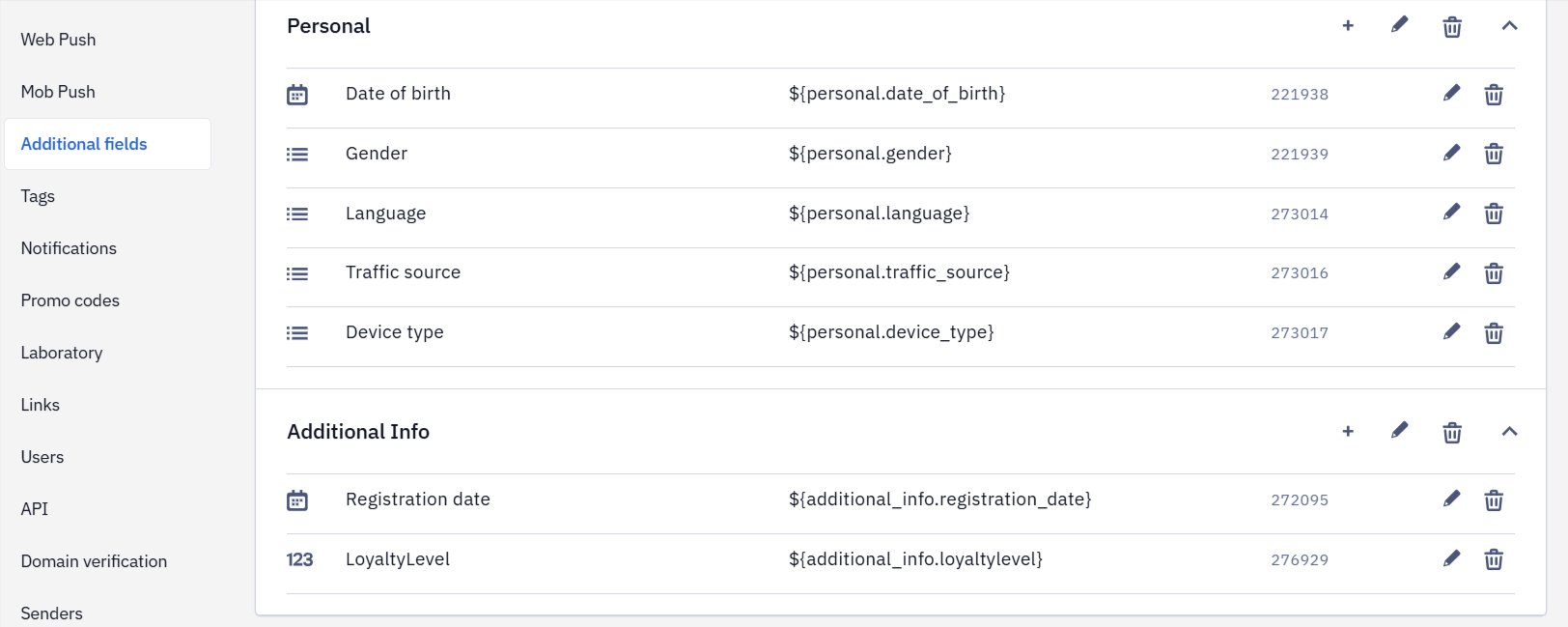
A single syntax makes it easier to copy variables into messages and reduces format-mismatch mistakes.
Updated about 1 month ago